
The Preservation Project

CONTRIBUTE TO THE PRESERVATION PROJECT
We are committed to completing this project, but it is currently underfunded.
The Preservation Project runs on community support, and there is no contribution too big or too small. We have raised $2,100 and are looking to fund the full project scope, which is $28,300. Every contribution goes toward documenting these stories. If this work matters to you, we'd be honored to have you contribute. Every contributor will receive an invitation to our viewing of film in the Fall.
We're grateful to Education Austin and Preservation Austin for their continued partnership. We've applied for additional funding through the Austin Film Society’s 2026 AFS Grant for Short Films.
If you're interested in being a partner in this work, please send us a note!
ATX116 is an LLC and contributions are not tax-deductible.
Our Purpose & Our Partners
Our name is ATX116 because it signifies the connection of all 116 campuses that existed in AISD when our organization was born.
To the school communities that recently closed– Barrington, Becker, Dawson, Oak Springs, Paredes, Ridgetop, Sunset Valley, Widén and Winn Montessori elementary schools, Bedichek and Martin middle schools, and International High School*: You will always be part of our story and the web of public education in Austin. And you will certainly always be a part of ATX116 — you are literally a part of our name.
Some folks have asked if we will change our name in light of the recent closures. We will not and never plan to. Our story marks a moment in time in Austin's larger history and places our organization and its work in the context of all the work that was done before it existed and all that will come after.
The Preservation Project is a community-based storytelling project to preserve and share the history of Martin Middle School through oral history interviews, short documentary film, photography, and community engagement in visual art. The project will culminate in a public exhibition and screening, offering Austin residents an opportunity to witness, honor, and learn from this school community.
What is happening now matters. Future communities will look back on this moment to learn from it. One interview participant in the Preservation Project from the Martin Middle School community named the stakes clearly: a responsibility to “preserve [our schools] at all costs”. Our advocacy goes on. We keep showing up.
Recording is wrapped. Editing is underway. We look forward to sharing more from this video storytelling project in the coming months, including a release this Fall and finding a home for full interviews in a long-term city archive.
We are honored to be a small part of preserving the lived experiences of our Austin school communities. Stay tuned.
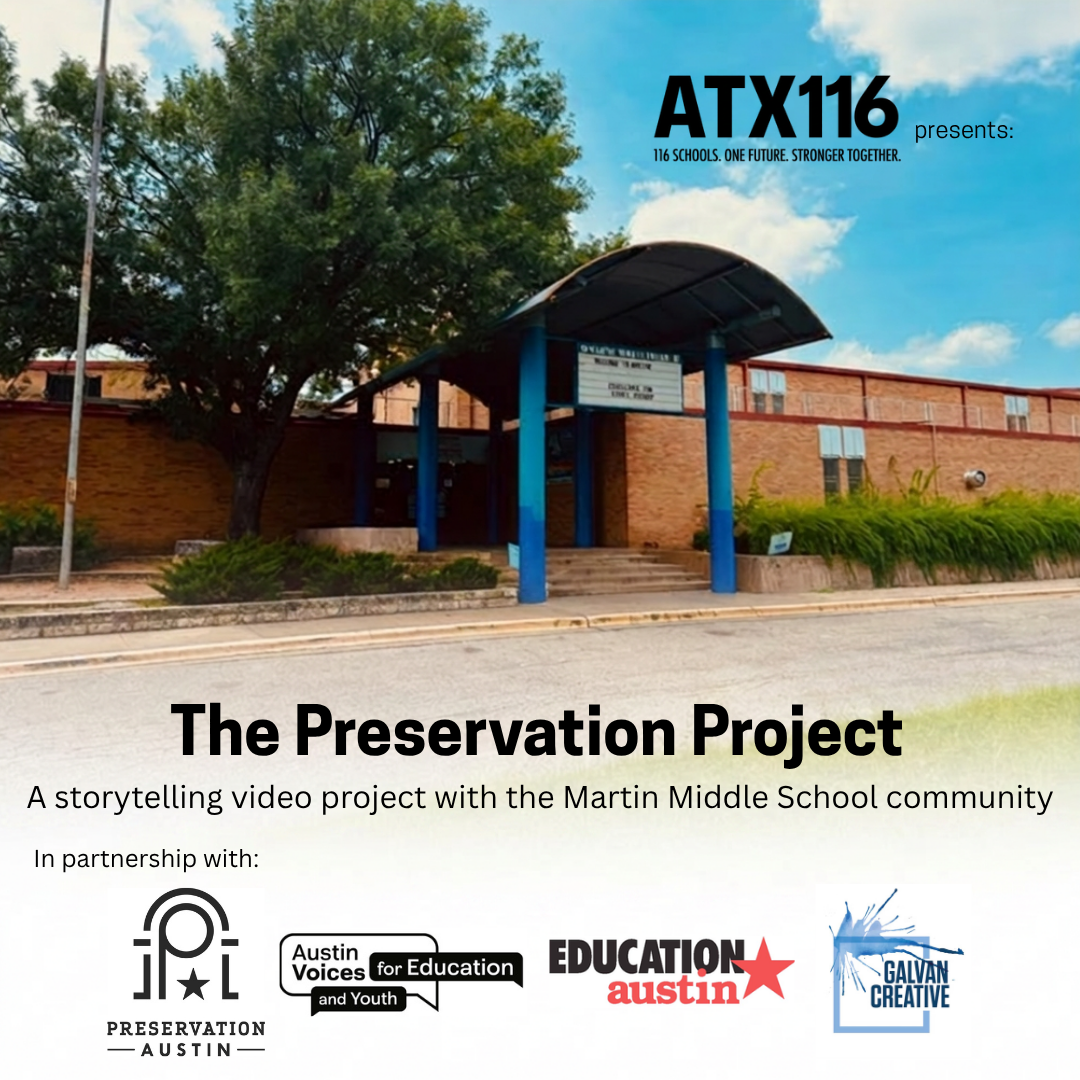
Thank you to our partners and collaborators for making this vision a reality:
Preservation Austin. This project was funded in part by a grant from Preservation Austin in support of its mission to empower Austinites to shape a more inclusive, resilient, and meaningful community culture through preservation.
Gail Buhler at Education Austin. Education Austin is the labor union representing teachers and staff in Austin ISD and is affiliated with the NEA, AFT, TSTA, Texas AFT, and the AFL-CIO. Gail is their Lead Organizer. We deeply appreciate your in-kind support, especially as you are simultaneously advocating for our teachers and students.
Gabriel Estrada at Austin Voices for Education and Youth for his collaboration and support welcoming us at STEAM Fest, where we captured community members' memories and experiences at Martin Middle School as they prepared for consolidation with another school community.
Frannie Sanchez at Austin Public Library (APL), who shared a vision for capturing these stories NOW, before school communities transition, and has been coordinating with APL branches across the city to support closing campuses in sharing their oral histories to be archived at Austin History Center. Thank you for sharing a table with us at Winn Elementary School's Butterfly Fest, where we loved listening to students share their stories of the impact the school had on them.
Paul Galvan at Galvan Creative and Kenneth Loyde at NewSchoolCreative, our immediate creative partners, who had the vision to transform these stories into visual media and the experience and talent to make this an opportunity for expressive art.
Special thanks to Gabby Garcia, Vincent Tovar, and Hanna Salmon for being our partners and part of our larger collaborative team in moving this project forward together. Your partnership made it possible for more community members to participate and share their story inclusively.
Last but not least, thank you to the Martin Middle School community members, alumni, staff, and students for welcoming us into your legacy event and trusting us with your stories. We appreciated every memory, story, feeling, and moment you shared, and we are committed to honoring that trust.
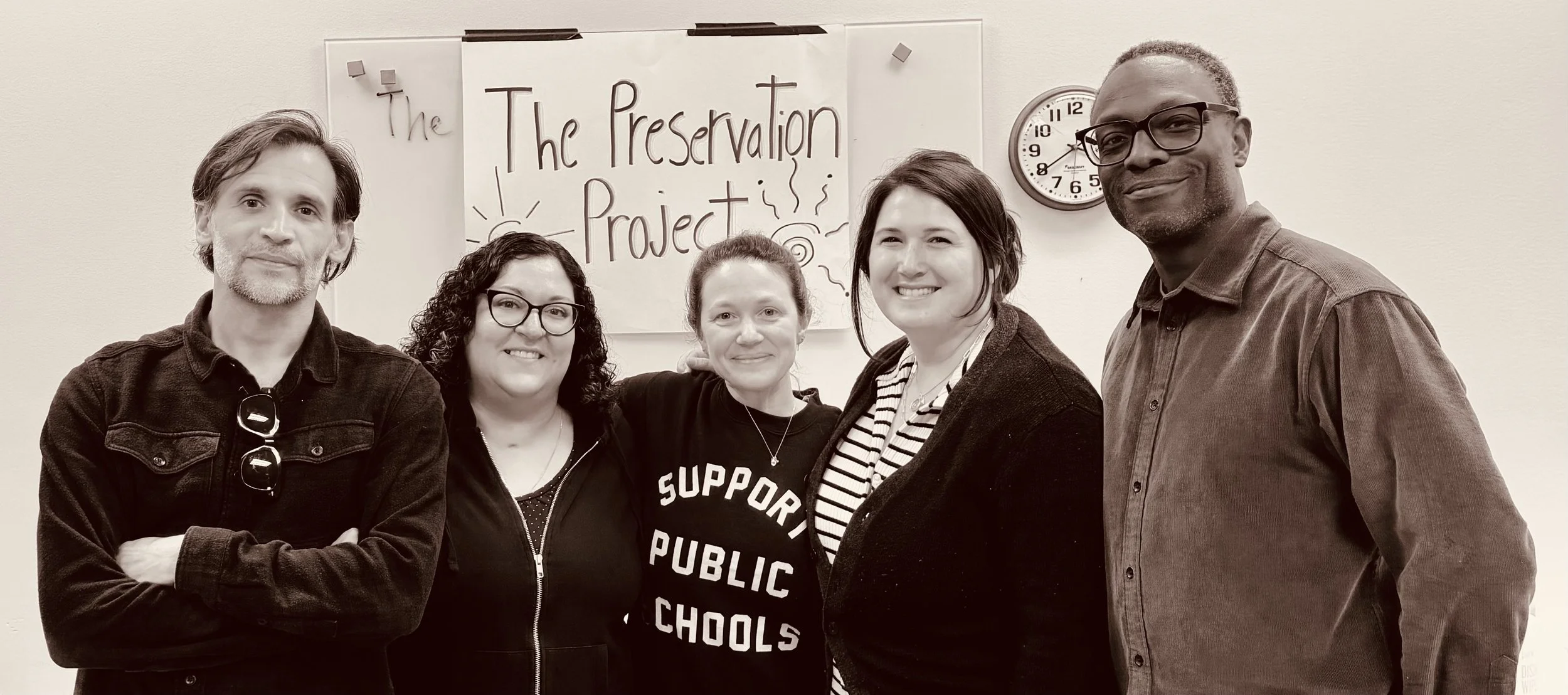
About the Team
-
Heather Wong, Director / Producer. Heather is an AISD parent and former AISD educator and instructional coach, as well as an ICF-certified professional coach and writer, who has spent years in East Austin schools, including Pecan Springs, Sims, Perez, Langford, and Dobie Middle School. She co-founded ATX116, a community-based advocacy and storytelling organization working across Austin ISD's schools to build a more equitable district, after years of watching school closures and state mandates fall hardest on the city's eastern neighborhoods. On the Preservation Project, Heather wrote the film's story treatment, led community outreach and story collection, and conducted oral history interviews with parents, educators, and alumni. She also built the project's funding foundation, securing partnerships with Preservation Austin and Education Austin, and led the grant strategy carrying the film through completion. Her direction is grounded in the trust built through two decades in Austin communities.
-
Paul Galvan, Co-Director / Cinematographer / Editor (Galvan Creative). Paul is a creative professional from Austin with decades of experience in filmmaking, music production, photography, and design and fabrication. As founder of Galvan Creative, he has produced work for major outlets including Lionsgate, IFC, DGA, CBS, C3, and Filmbuff, and remains an active contributor to Austin's independent creative community. He has taught and designed film education programs at public institutions and in private practice. Paul attended Martin Middle School in the 1990s and returns to it now as a filmmaker, leading cinematography, videography, and the post-production edit, and shaping the visual language of this film from inside the community it documents.
-
Jessie Neufeld, Producer.* Jessie is an Austin attorney and AISD parent who has served on various PTA boards for almost six years. Most of that time she has served as Advocacy Chair, educating and engaging school communities around systemic changes needed at the district and state level to ensure all AISD students have the ability to learn, grow and thrive. She co-founded ATX116 to build a more equitable Austin ISD through community engagement, information sharing, and advocacy. On the Preservation Project, Jessie built the participant consent framework governing how every story is used, stored, and shared, keeping each storyteller in control of their own narrative. She was on the ground at Martin capturing student stories in writing, reviews all footage and grant applications, and represents ATX116 alongside Heather in the final review of the film. Her work keeps the project’s vision aligned with that of the community the project aims to celebrate and honor.
*Jessie does not provide legal advice to the Preservation Project or serve as its legal counsel.
-
Kenneth Loyde, Co-Producer / Consulting Producer (NewSchoolCreative). Ken has lived in Austin since 1993, an education leader with over 20 years of experience. He served as AISD's Social Emotional Learning and Cultural Proficiency & Inclusivity Specialist, supporting Martin, and currently serves on the board of Anthropos Arts, a nonprofit supporting Martin MS Latino and Latina students through music. As one of the project's immediate creative partners, he guides how the Preservation Project engages the Martin community with cultural proficiency and care, shaping story consultation and community accountability alongside project coordination across the film’s production timeline.
-
Gabby Garcia: Production and Community Engagement Support. Gabby made broader community participation possible: welcoming community members, capturing student stories in writing and other formats, and staffing engagement events. Her involvement ensured more voices could be shared in Spanish, inclusively, and on participants' own terms.
Tracing Our History of Closures & Consolidations
Our city’s public school history is connected to a web of closures and consolidations beginning in 1971 and continuing today. This project seeks to document and organize that history, making the broader pattern more visible and building shared awareness and understanding of school closures concentrated in schools and communities where most students are economically disadvantaged and most are Hispanic or African American.
Source note: Student groups including “African American” and “Hispanic” and "economically disadvantaged" follow TEA's Texas Academic Performance Report definitions. TEA counts a student as economically disadvantaged if the student is eligible for free or reduced-price lunch or other public assistance.
From L.C. Anderson (1889-1971) to Blackshear (1891-2028), Austin will have closed and consolidated 24 schools.
Of the 21 schools with data, 17 schools served families and children in communities where the majority of students qualified as economically disadvantaged.
-
Both L.C. Anderson High School (1889) & Kealing Junior High (1930) were historically Black public schools in Austin that closed under federal desegregation order.
After decades of maintaining a segregated system, AISD responded to federal pressure by closing the two East Austin schools and busing Black students to predominantly white schools across the city rather than requiring white students to attend the historically Black schools.
L.C. Anderson and Kealing had been a center of community life in East Austin, connecting students, families, teachers, churches, businesses, and neighborhood institutions. Its closure disrupted those networks and diminished schools that had served as a source of Black leadership, pride, and belonging.
After closing, Kealing served as an AISD annex and hosted community programs before its building was devastated by fire in 1983.
The former Anderson campus became the home of Austin Community College and later AISD’s Alternative Learning Center; it was eventually redeveloped as Eastside Early College High School.
Kealing reopened in 1986 as a neighborhood school with a magnet program. drawing largely white and Asian students from across the district, and a neighborhood academy serving mostly Black and Hispanic kids from the surrounding community. Per KUT, Kealing principal Kenisha Coburn said in 2017 that the same racial line once drawn across the neighborhood now runs straight through the building’s hallways.
Some contextual patterns to note: In the 1980s, the district brought magnet programs to East Austin to draw white families back. The Science Academy opened at LBJ, a math and science magnet at Kealing, and the Liberal Arts Academy at Johnston. The buildings were integrated. The classrooms often were not. In 1995, an LBJ senior named Shante Clark was ranked 99th in her class with magnet students counted and 5th without them. In 2004, nearly 200 LASA students took an AP exam. At LBJ, one student did (Source: James Rodriguez, A School Divided: The History of LBJ and LASA, UT Austin Plan II thesis, 2018).
Today, Kealing still houses both a Magnet and an Academy program and is 37.5% white, with 23.9% of students economically disadvantaged, nearly half the district average. Eastside Early College High School, now located on the former Anderson site, serves a student population that is 76.7% Hispanic, 18.3% African American, and 89.5% economically disadvantaged, well above the district average.
Today, the demographics of these two campuses make clear that the story of desegregation did not end with the closing of Anderson and the movement of students across the city.
-
Porter Middle School (1958) had their boundaries redrawn in 1999 which pulled a wealthier feeder area out, pushing economically disadvantaged student enrollment from 50% to 80% before closure. Reopened as Ann Richards School for Young Women Leaders in 2007, a lottery-based school of choice. Since 2020-21, white enrollment there has risen from 30% to 37%, Hispanic enrollment has fallen from 59% to 45-51%, Black students make up between 3.2-4% consistently, and economically disadvantaged students have dropped from 42% to roughly 33%.
-
Johnston became the first in Texas ever closed by the state for poor test performance. Reopened that same year as Eastside Memorial, split into two campuses in 2009, merged back in 2011. A plan to hand it to IDEA Public Schools, a charter operator, became a rallying point for East Austin parents and advocates, who fought it off. In 2017, the school relocated onto the old L.C. Anderson site; and was renamed Eastside Early College High School at the L.C. Anderson campus in 2021.
A bit of backstory: In November 2001, the school board voted 6-3 to remove the Liberal Arts Academy from Johnston and combine it with the Science Academy at LBJ, forming the Liberal Arts and Science Academy. The merger took effect in the 2002-03 school year. It left Johnston underenrolled and mostly resegregated, and the campus had gone through five principals in two years. Magnet students' test scores had been lifting Johnston's overall average and masking the lower scores of non-magnet students. Two years after the Liberal Arts Academy left, Johnston failed to meet state accountability standards for the first time.
-
Allan opened as a junior high in 1916, moved to 4900 Gonzales in East Austin in 1957, and became an elementary school in 1980. In 1964, it was one of the first AISD campuses where Black teachers integrated the all-white staff.
In 2008-09, Allan was 91% Hispanic, 8% Black, and less than 1% white. Nearly 97% of students were economically disadvantaged, and more than half were English learners. It was not a failing school.
In 2011, the board closed Allan and handed it to IDEA to run as a charter, with the goal of improving Eastside Memorial, which Allan fed into. Of 675 applicants, only 175 came from the Eastside feeder pattern. After opposition from PRIDE of the Eastside, the board ended the contract in 2012. Eighty percent of Allan's students left with IDEA, costing AISD about $60 million over seven years, and the district left the campus empty.
In 2018, the Alternative Learning Center moved in, and the board renamed the campus the Anita Ferrales Coy Facility.
-
Pearce Middle School opened in 1958 between University Hills and Windsor Park in Northeast Austin. In 2007-08, Pearce enrolled roughly 550 students. About 68% were Hispanic and 31% African American, and 94% were economically disadvantaged. In July 2009, the TEA commissioner ordered Pearce closed. Weeks later, the state reversed course, and the school reopened as a repurposed campus under a new academic model. In January 2013, the board voted 5-3 to convert Pearce into a single-sex school, and in April 2014 it voted to rename the campus for Bertha Sadler Means, a longtime AISD educator and civil rights leader. Pearce closed as a coed middle school at the end of the 2013-14 school year and reopened that fall as the Bertha Sadler Means Young Women's Leadership Academy. Today, Sadler Means serves roughly 280 students. The student body is 70.5% Hispanic, 16.2% Black, 6.5% white, and 4.7% Asian, and 80.9% are economically disadvantaged. Through the 2022 bond, AISD demolished the original building and is replacing it with a $78 million campus.
Gus Garcia Middle School opened in 2007. In January 2013, despite only 45% support in a district phone survey, the board voted 5-3 to change it. In 2014, AISD closed Garcia as a coed middle school and reopened the campus as the Gus Garcia Young Men's Leadership Academy. Today, Garcia serves 243 students, down 42.8% since 2016. Eighty-two percent are Hispanic, and 97.5% are economically disadvantaged, about double the district rate of 48.4%.
-
Metz Elementary (1916) — students were 4.6% African American and 86.2% Hispanic, with 96.5% qualifying as economically disadvantaged. Located in East Austin, historically one of the city's Mexican American neighborhoods. Established in 1916; current campus built in 1993.
Brooke Elementary (1954) — as of 2012-13, the most recent available breakdown, students were 11.4% African American and 83.7% Hispanic, with 95.8% qualifying as economically disadvantaged. Enrollment had fallen to 271 students by 2018-19, down from 400 in 2011-12. Brooke sits in Govalle, a historically Mexican-American East Austin neighborhood. Closed after the 2019-20 school year. AISD's own closure plan stated the consolidation would "help support the district's underserved Black and Hispanic students". In April 2025, the AISD Board declared the former Brooke campus surplus, with a sale to a developer for mixed-use apartments expected to close in 2026.
Sims Elementary (1956) — as of 2018-2019, the student body included 41.2% African American, 54.4% Hispanic, 97.3% economically disadvantaged. Built in 1956 on a 7.95-acre site at 1203 Springdale Road in East Austin. Closed after the 2020–21 school year.
Pease Elementary (1876) was downtown, blocks from the Capitol, a registered Texas historic landmark since 2013, and by AISD's own account the oldest continuously running elementary school in the state. 42.67% white, 40.95% Hispanic and 15.9% economically disadvantaged, an all-transfer campus rather than a zoned neighborhood school. Closed on a 6-3 vote, the same vote as Brooke, Metz, and Sims, despite a failed board amendment to spare it. The district's stated reason was different from the others: Pease's historic building would be too costly to modernize. It sat empty for nearly five years before AISD leased it to United Way for a child care center, backed by $3 million in federal money, set to open in 2027.
-
Widen Elementary (1986) — students are 86.1% Hispanic, with 91.5% qualifying as economically disadvantaged. Enrollment has declined from 566 students in 2016 to 339 in 2026, a decrease of about 40%.
Dawson Elementary (1954) — students are 77% Hispanic, with 78.3% qualifying as economically disadvantaged. Enrollment has declined from 381 students in 2016 to 152 in 2026, a decrease of about 60%.
Bedichek (1972) — students are 84.3% Hispanic, 6.4% white, and 6.4% Black, with 85% qualifying as economically disadvantaged.
Barrington (1969) — students are 87.6% Hispanic and 7.3% Black, with 97.1% qualifying as economically disadvantaged.
Oak Springs (1958) — students are 58.7% Hispanic, with 97.7% qualifying as economically disadvantaged. Other racial/ethnic categories are not included because I have not found a sufficiently reliable source for a complete breakdown. A $46.7 million voter-approved modernization is set to be completed in 2028. During renovations, Oak Springs students are temporarily relocating to Blackshear. When construction is complete, Oak Springs students are expected to return to a new facility alongside the Blackshear student body. Per Austin Current, Community members have raised concerns about whether the campus will have the capacity to serve both student populations. As Blackshear parent Rachel Bowden put it, “When the bond plan was made to rebuild Oak Springs, the cost was $47 million. It wasn’t $47 million and closing Blackshear.”
Winn Montessori (1970) — students are 58% Hispanic, 19.2% white, 12.7% Black, 6.8% two or more races, and 2.6% Asian, with 58.6% qualifying as economically disadvantaged. It was one of the more economically and racially diverse schools in the city. AISD's only Montessori program; a strand of the program itself relocated to Reilly while Winn's community split into three elementary schools.
Ridgetop (1908) — students were roughly 51% Hispanic and 39% white, with 16.3% qualifying as economically disadvantaged. The school was rebuilt in 1948 and became part of AISD in 1950, giving it a long institutional history that predates its incorporation into the district. Ridgetop, Becker, and Sunset Valley were known for their wall-to-wall dual language program, where every student takes half their classes in English and half in Spanish. Over the past 15 years, the share of Hispanic and Black students, and of Emergent Bilingual students specifically, steadily declined.
Becker Elementary (1936) — students were 51.9% Hispanic and 41.6% white, with 18.4% qualifying as economically disadvantaged. Becker is also a wall-to-wall dual language campus. AISD's Director of Planning Services acknowledged that Becker and its sister campuses have shifted over time toward serving fewer emergent bilingual students and more English-proficient students.
Sunset Valley (1971) — students were 57.4% Hispanic and 35.9% white, with 29.9% qualifying as economically disadvantaged. Sunset Valley is also a wall-to-wall Spanish dual language campus, and one of four AISD schools (alongside Becker, Ridgetop, and Reilly) to have their dual language programs relocated entirely, as the district works to rebalance emergent-bilingual and English-proficient enrollment across its dual language campuses.
International High School (2003) — students are 85.6% Hispanic, with 98.9% qualifying as economically disadvantaged. Served newly arrived immigrant students; closed after enrollment collapsed from 213 to 95 students in a single year, a drop district leaders tied directly to immigration enforcement fear.
Paredes Middle School (1998) — students are 80.96% Hispanic, 7.04% African American, and 5.76% white, with 82.6% qualifying as economically disadvantaged. Closed in July 2026, less than a year after the district's board voted to close ten other campuses, the eleventh closure in a single year.
Martin Middle School (1967) — Built specifically as Austin's first fully integrated school, opening with Black, white, and Hispanic students together. Students are 79.76% Hispanic and 14.57% Black, with 92.2% qualifying as economically disadvantaged and 44% Emergent Bilingual. AISD spent 2022 bond money building a new student mental health center at Martin in 2025, then voted to close the school months later.
Blackshear Elementary School (1891) — Students are 40.19% Hispanic, 25.70% white, 21.96% Black, 10.28% two or more races, and 1.87% Asian; 55.4% are economically disadvantaged. One of AISD’s most racially and economically diverse schools, Blackshear is also the district’s first elementary school devoted to the arts. Founded to serve Gregory Town, a Reconstruction-era freedom colony, as a segregated Black school, it is Austin’s oldest operating public elementary school and one of the oldest continuously operating Black public schools in the country. Generations of Blackshear students went on to Kealing and L.C. Anderson, which closed in 1971.
A note on the data: these school closures and consolidations, and the decades of closures before them, carry more history and nuance than this piece can capture. The goal isn't a complete accounting of every school. It's to show a pattern: schools serving majority economically disadvantaged students have closed repeatedly, disproportionately impacting Black and Hispanic students, decade after decade, across this district. The demographic figures throughout this section are what could verify through reliable news sources, AISD, and TEA records. Some campuses have full breakdowns, others don't. Some figures match the exact closure year; others come from the closest year available.